Imagine walking into your kitchen and being greeted by the warm, irresistible scent of fresh-baked cookies. Homemade chocolate chip cookies do more than taste better they create memories, whether for an everyday snack or a special moment like a Teacher’s Day cake. They’re personal, customizable, and far superior to most store-bought options.
This guide teaches a reliable Nestle chocolate chip cookie recipe that delivers soft, chewy cookies with crisp edges. You’ll learn the small techniques that make a big difference measuring in grams for consistency, chilling the dough for flavor and shape, and choosing the right chocolate chips and mix-ins. Follow these steps and you’ll bake cookies that friends and family prefer over packaged chip cookies.
Ready to start? Read on for the history, exact ingredient weights, and step‑by‑step mixing and baking tips and don’t forget to preheat your oven before you begin.
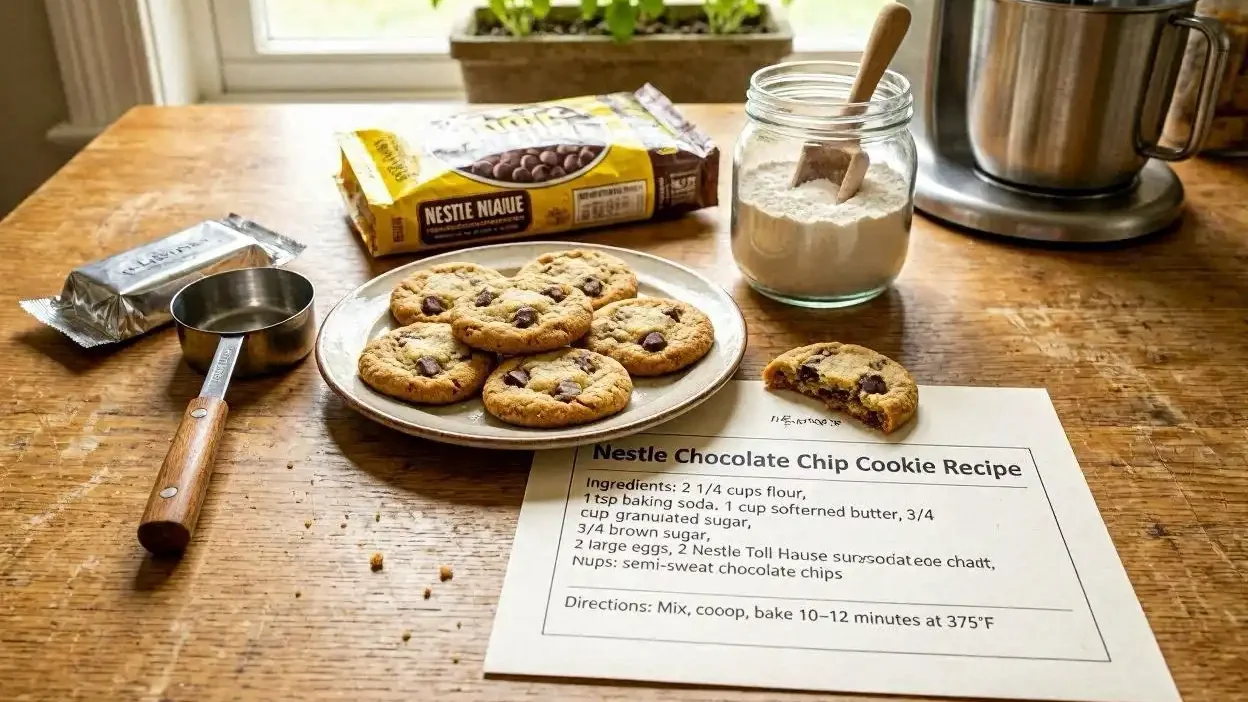
Nestle Chocolate Chip Cookie Recipe
Equipment
- Mixing bowls, electric hand or stand mixer, measuring cups or kitchen scale, measuring spoons, rubber spatula, cookie scoop, baking sheets, parchment paper, cooling rack.
Ingredients
- 1 cup 227 g unsalted butter, softened
- ¾ cup 150 g granulated sugar
- ¾ cup 165 g packed brown sugar
- 1 teaspoon vanilla extract
- 2 large eggs
- 2¼ cups 360 g all-purpose flour
- 1 teaspoon baking soda
- 1 teaspoon salt
- 2 cups 340–400 g Nestle Toll House semi-sweet chocolate chips
- 1 cup chopped walnuts optional
Instructions
- Preheat oven to 375°F (190°C).
- Line baking sheets with parchment paper.
- Cream butter, granulated sugar, and brown sugar until light and fluffy.
- Beat in eggs one at a time, then add vanilla extract.
- Whisk flour, baking soda, and salt together.
- Gradually mix dry ingredients into the wet mixture until just combined.
- Fold in chocolate chips and walnuts if using.
- Chill the dough for 30 minutes for thicker cookies (optional but recommended).
- Scoop about 1½ tablespoons of dough onto prepared baking sheets, spacing them 2 inches apart.
- Bake for 9–11 minutes, until the edges are lightly golden and the centers are still soft.
- Cool on the baking sheet for 2–3 minutes, then transfer to a wire rack.
- Preheat oven to 375°F (190°C).
- Line baking sheets with parchment paper.
- Cream butter, granulated sugar, and brown sugar until light and fluffy.
- Beat in eggs one at a time, then add vanilla extract.
- Whisk flour, baking soda, and salt together.
- Gradually mix dry ingredients into the wet mixture until just combined.
- Fold in chocolate chips and walnuts if using.
- Chill the dough for 30 minutes for thicker cookies (optional but recommended).
- Scoop about 1½ tablespoons of dough onto prepared baking sheets, spacing them 2 inches apart.
- Bake for 9–11 minutes, until the edges are lightly golden and the centers are still soft.
- Cool on the baking sheet for 2–3 minutes, then transfer to a wire rack.
Notes
- Store cookies in an airtight container for up to 1 week.Recipe Tips Chill the dough for richer flavor and thicker cookies. Use a kitchen scale for the most accurate measurements. Do not overmix after adding the flour. Remove cookies when the centers still look slightly underbaked; they will continue cooking on the baking sheet. Sprinkle flaky sea salt on top for extra flavor.
- Freeze cookie dough balls for up to 3 months.
- Bake frozen dough by adding 1–2 extra minutes.
- Add extra chocolate chips for gooier cookies or chopped nuts for additional crunch.
Nutrition (Approximate per cookie)
- Calories: 210 kcal
- Carbohydrates: 27 g
- Protein: 2.5 g
- Fat: 11 g
- Saturated Fat: 6.5 g
- Cholesterol: 30 mg
- Sodium: 130 mg
- Fiber: 1 g
- Sugar: 17 g
What Is the Nestle Chocolate Chip Cookie Recipe and Why Does It Work
The Nestle chocolate chip cookie recipe is a cornerstone of American baking because it marries simple ingredients with dependable technique. Loved for its flavor and approachability, the Toll House recipe gives home bakers a reliable path to classic chocolate chip cookies that are crisp at the edges and tender inside.
The Story Behind the Original Toll House Cookie Recipe (1939)
In 1939, Ruth Wakefield of the Toll House Inn in Whitman, Massachusetts, is credited with accidentally creating the first chocolate chip cookie. She chopped up a Nestlé semi‑sweet chocolate bar while making cookies expecting it to melt; instead, the chocolate held its shape and created pockets of melty chocolate throughout the dough.
Ruth’s guests loved the result, and she shared the recipe with Nestlé. Nestlé printed that recipe on the back of their chocolate bar packaging, and the Toll House cookie became a household favorite.
How Toll House and Nestlé Turned It Into a Household Name
By the 1940s, the chocolate chip recipe printed on the back of the bag was widely known. Nestlé’s distribution and branding helped make the Toll House cookie synonymous with home baking—so much so that “Toll House” became shorthand for the original chocolate chip cookie recipe.
Why Homemade Beats Store-Bought Every Time
There are a few clear reasons homemade chip cookies outshine packaged alternatives:
- Freshness and ingredient control: You choose the quality of butter, chocolate, and sugar and avoid preservatives found in many store-bought cookies.
- Customization: Want extra chocolate? Add more chocolate chips. Prefer nuts or a sprinkle of flaky sea salt? Tailor the dough to your taste.
Sample customizations: increase chocolate chips for a gooey finish, fold in chopped walnuts for crunch, or finish with a pinch of sea salt for balanced sweetness.
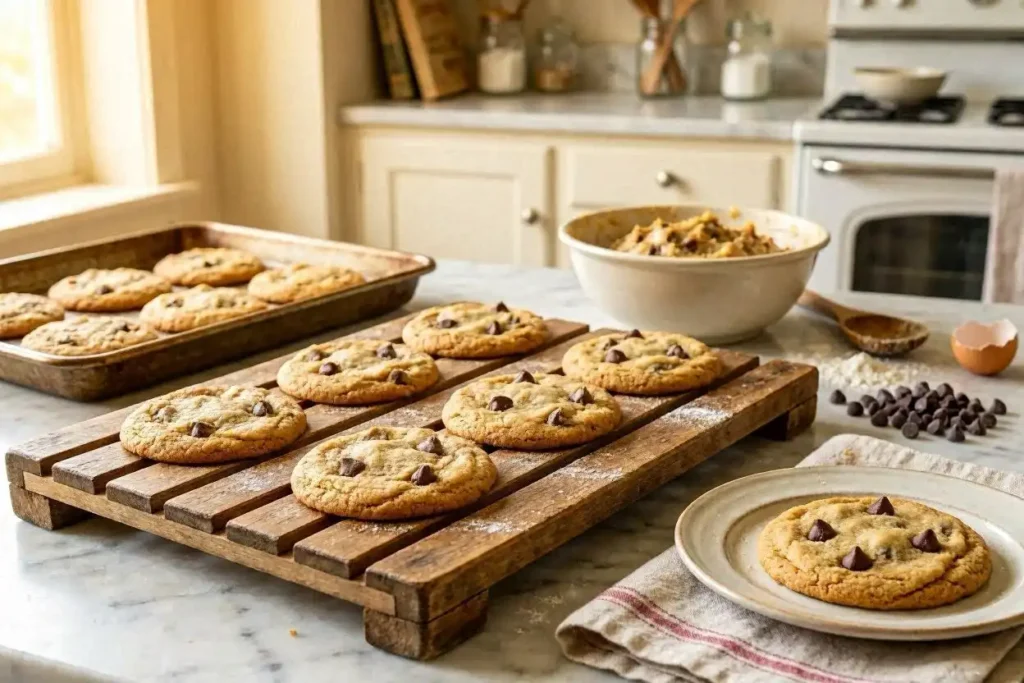
Nestle Toll House Cookie Recipe in Grams: Precision for Perfect Cookies
Baking reliably great cookies starts with accurate measurements. Converting the Nestle Toll House cookie recipe to grams removes the guesswork that comes from cup-to-cup variation and helps you get consistent dough and predictable results every batch.
Why Weighing Ingredients Matters for Baking Success
A kitchen scale is one of the best investments for home bakers. Weighing ingredients matters because:
- Consistency: Weight ensures each batch uses the same amount of flour, sugar, and butter, so cookies bake the same way each time.
- Precision: Volume measures (cups) vary by how you scoop or sift; grams are exact.
- Better results: Recipes written in grams reduce texture and spread variability, producing more predictable chewiness and edge color.
The Science of Accurate Measurements
Flour density changes with handling: sifted flour can measure significantly less than scooped or packed flour. Typical ranges you’ll see in recipes are about 120–160 grams per cup depending on method; that difference alone can make cookies cakier or flatter.
Common Measurement Conversions for Home Bakers
Use these commonly accepted conversions as a starting point (note: slight variation exists by brand and how flour is treated):
- 1 cup all-purpose flour ≈ 120 grams (sifted reference)
- 1 cup granulated sugar ≈ 200 grams
- 1 cup packed brown sugar ≈ 220 grams
Essential Ingredient Weights for the Best Chocolate Chip Cookies Recipe
Below is a gram-based ingredient list that maps to a full classic Toll House–style batch. This gives you a precise baseline to follow or scale up/down:
Flour and Sugar Measurements in Grams
- All-purpose flour: 360 grams
- Granulated sugar: 200 grams
- Brown sugar (packed): 220 grams
Butter and Chocolate Chip Quantities
- Butter: 227 grams (2 sticks)
- Chocolate chips: 340–400 grams depending on how chocolate-forward you want your cookies
These weights create a dough that balances structure (from flour), sweetness (from sugars), and richness (from butter and chocolate). If you prefer slightly less sweet, try 320 grams of chips; for very chocolatey cookies, push toward 400 grams.
Quick How-To: Zeroing and Taring Your Scale
Place your mixing bowl on the scale, press the tare/zero button, then add ingredients directly into the bowl to measure each item without extra dishes. This keeps the process tidy and accurate.
Mastering gram measurements will improve repeatability and lead to better chocolate chip cookies every time. If you bake frequently, consider printing a small gram-conversion card for your kitchen as a quick reference before measuring ingredients.
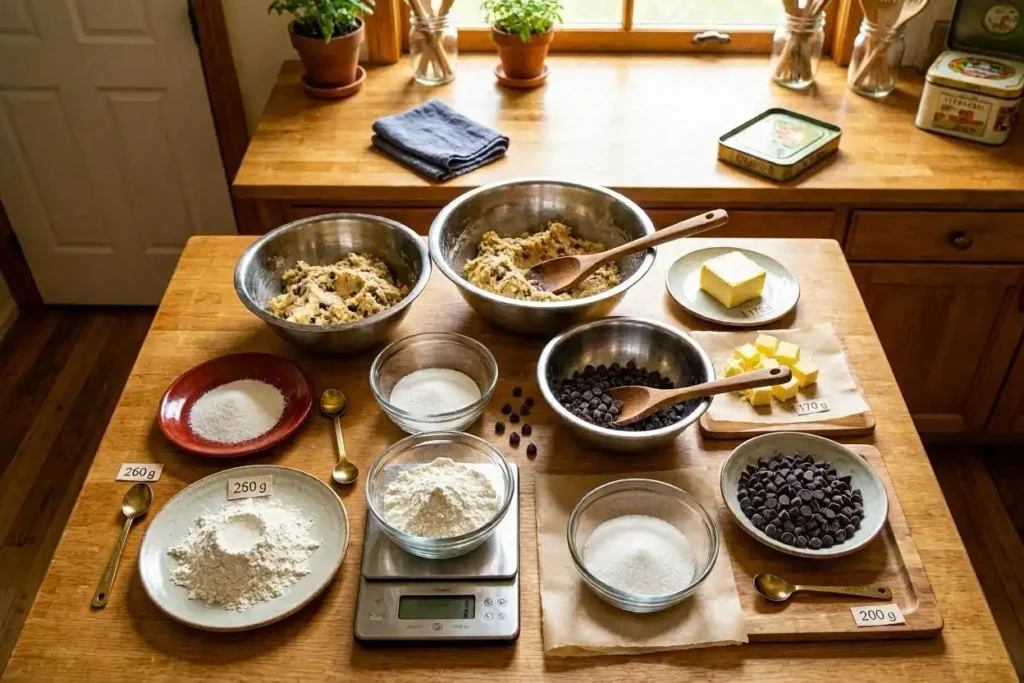
Easy Chocolate Chip Cookies Recipe: Gathering Your Ingredients
Before you mix, gather everything so the bake goes smoothly. This easy chocolate chip cookies recipe uses common pantry ingredients and a few small techniques to deliver consistently soft, chewy cookies with crisp edges.
Complete Ingredient List for Classic Chocolate Chip Cookies
Here’s everything to have measured and ready (volume version):
- 1 cup unsalted butter, softened
- 3/4 cup granulated sugar
- 3/4 cup packed brown sugar
- 1 teaspoon vanilla extract
- 2 large eggs (room temperature)
- 2 1/4 cups all-purpose flour
- 1 teaspoon baking soda
- 1 teaspoon salt
Quick checklist before you start: preheat the oven (see bake section), line two sheet pans with parchment paper, and set out a 1.5-tablespoon scoop or two spoons for portioning.
Step-by-Step: Mixing Your Nestle Toll House Chocolate Chip Cookies Recipe
Follow these mixing steps to build structure and tenderness in your cookie dough.
Preparing the Wet Ingredients
Creaming Butter and Sugars Properly
Soften the butter to room temperature so it creams smoothly. In a large bowl, combine:
- 1 cup ( softened) unsalted butter
- 3/4 cup granulated sugar
- 3/4 cup packed brown sugar
Use a hand mixer or stand mixer and beat on medium speed for 2–3 minutes, until the mixture is light in color and fluffy — this traps air for tender cookies.
Adding Eggs and Vanilla Extract
Beat in the eggs one at a time, then add 1 teaspoon vanilla extract. Mix until just combined about 30 seconds scraping the bowl so everything is uniform.
Incorporating Dry Ingredients
The Right Way to Add Flour
In a separate bowl, whisk together:
- 2 1/4 cups all-purpose flour
- 1 teaspoon baking soda
- 1 teaspoon salt
Add the dry mixture to the wet ingredients in two additions, mixing on low until just combined. Stop as soon as you no longer see streaks of flour to avoid overmixing, which can make cookies tough.
Mixing Until Just Combined
The dough should be soft and slightly tacky but manageable. If it feels overly sticky, chill for 15–30 minutes; if too dry, add 1 teaspoon of milk or an extra egg yolk.
Adding Chocolate Chips and Optional Mix-ins
Creating Chocolate Chip Walnut Cookies
Fold in:
- 2 cups Nestle Toll House semi-sweet chocolate chips
- 1 cup chopped walnuts (optional)
Gently fold by hand so the chips stay intact and the dough remains airy.
When to Fold in the Chocolate
Add chips and any nuts at the very end, just until distributed. Too much mixing after adding chips will warm the dough and change its texture.
Nestle Chocolate Chip Cookie Dough: Achieving the Perfect Consistency
Getting the right consistency for your nestle chocolate chip cookie dough is one of the biggest factors in baking outstanding cookies. Dough texture affects spread, chew, and appearance master it and your cookies will consistently look and taste bakery‑worthy.
Understanding Dough Texture
The ideal cookie dough is soft and slightly tacky but still holds its shape when scooped. Check for these ready‑to‑bake signs:
- The dough is slightly tacky to the touch but manageable.
- It holds together when scooped or rolled into balls.
- It doesn’t cling excessively to your hands or the mixing bowl.
Signs Your Dough Is Ready for Baking
Before baking, look for these cues:
- Surface is smooth and evenly mixed with no streaks of flour.
- Dough feels cool to the touch (good sign if you chilled it).
- Scooped rounds keep their shape on the sheet instead of collapsing into a puddle.
Troubleshooting Sticky or Dry Dough
If your dough is too sticky:
- Chill it for 15–30 minutes to firm the butter and make it easier to handle.
- Add up to 1 tablespoon of flour at a time, mixing gently, until it’s manageable.
If your dough is too dry:
- Add 1 teaspoon of milk at a time (or an extra egg yolk for richness) until the dough comes together.
- A small extra splash of vanilla or a teaspoon of brown sugar can also improve moisture and flavor.
Chilling the Dough for Better Results
Chilling is a simple step that significantly improves texture and flavor. Here’s a quick guide on timing and results:
How Long to Refrigerate Your Dough
Recommended chilling times and expected outcomes:
- 30 minutes — slight chill for easier scooping and a slightly wider spread.
- 2 hours — better flavor development and reduced spread, for a chewier edge and tender center.
- Up to 24 hours — maximum flavor depth and the chewiest, most intensely flavored cookie.
Benefits of Cold Dough for Shape Retention
Cold dough delivers several baking advantages:
- It solidifies the butter so cookies spread less and keep a taller, more attractive profile.
- Cold dough allows flavors to meld, yielding a richer, more developed chocolate and brown sugar taste.
- Chilled dough produces a more consistent texture from batch to batch.
Quick if/then checklist: if sticky → chill 15–30 minutes or add flour (1 tbsp increments); if dry → add milk (1 tsp increments) or an egg yolk. For best results, plan ahead: prepare dough one day before baking and refrigerate overnight for deeper flavor and ideal chew.
Baking Toll House Soft Chocolate Chip Cookies to Perfection
To bake Toll House soft chocolate chip cookies that are reliably soft and chewy, focus on oven temperature, portioning, and timing. Small adjustments—like using an oven thermometer, chilling the dough, and choosing the right scoop—make a big difference in texture and appearance.
Preheating Your Oven Correctly
Preheat your oven to 375°F (190°C) for classic Toll House cookies. Because home ovens vary, use an oven thermometer to confirm the actual temperature and avoid under- or over-baking.
Temperature Settings for Soft and Chewy Cookies
- 375°F (190°C) — classic Toll House result: crisp edges, tender centers.
- 350°F (177°C) — slightly slower bake for a more even, golden color.
- 325°F (163°C) — lower and slower for an even softer, thicker cookie.
Using an Oven Thermometer for Accuracy
An inexpensive oven thermometer removes guesswork. Place it in the center of the oven and adjust temperatures based on its reading for consistent results.
Shaping and Spacing Your Cookies
Consistent shaping ensures even baking. Use a 1.5-tablespoon disher (or a 1.5-tablespoon scoop) for standard cookies so bake times remain predictable.
Cookie Scoop Recommendations
- 1.5-tablespoon disher — standard cookie (recommended).
- 1-tablespoon scoop — bite-sized cookies.
- 2-tablespoon scoop — big fat chewy chocolate cookies.
Proper Distance Between Cookies on the Sheet
Place dough balls at least 2 inches apart to prevent merging. Use parchment or silicone liners on your sheets for even browning and easy cleanup.
Visual Cues and Bake Times for Doneness
Bake time depends on scoop size and oven. Start checking visually within the ranges below and adjust by 30-second increments if needed:
- 1-tablespoon scoop: 8–9 minutes
- 1.5-tablespoon scoop: 9–11 minutes
- 2-tablespoon scoop: 10–12 minutes
Look for set, lightly golden edges with centers that still look slightly soft — the cookies will finish cooking on the hot sheet (carryover cooking) and firm up to a soft center.
When to Remove from Oven for Big Fat Chewy Chocolate Cookies
For big fat chewy chocolate cookies, remove when edges are golden but centers still jiggle slightly. Let them rest on the baking sheet for 2–3 minutes before transferring to a wire rack; this preserves the soft middle while letting edges set.
Understanding Carryover Cooking
Carryover cooking means cookies continue to cook after you remove them from the oven because the sheet and centers retain heat. Factor this into your timing—pull them when centers are just shy of done for perfect chew.
Nestle Toll House Cookies 1/2 Recipe: Making Smaller Batches
If you don’t need a full dozen or want to test a variation, halve the recipe. Halving reduces waste and speeds up testing without changing technique—just halve every ingredient and watch bake times closely.
When to Halve the Original Recipe
Good reasons to make a half recipe:
- Perfect portions for two people or small households.
- Testing mix-ins or different chocolate types without committing to a full batch.
Adjusting Baking Time for Smaller Batches
Smaller batches don’t change oven physics, but fewer sheets in the oven can slightly alter heat distribution. Monitor the first tray closely and start checking for doneness a minute or two earlier than usual.
Monitoring Your Cookies Closely
Record the exact bake time that works for your oven and scoop size—this makes subsequent batches predictable. Time your first tray and note the minutes and oven rack used.
Storage Tips for Fresh Cookies
- Store baked cookies in an airtight container at room temperature for up to one week; add a slice of bread to keep them soft.
- For longer storage, freeze unbaked dough balls on a sheet, then transfer to a freezer bag; bake from frozen, adding 1–2 minutes to the bake time.
Customizing Your Chocolate Chip Cookies Nestle Recipe for Any Occasion
Once you’ve nailed the classic Nestle chocolate chip cookie, variations let you tailor cookies for events, diets, or flavor experiments. Below are easy swaps and a ready-to-bake variation so you can test one this week and share the results.
Peanut Butter Chocolate Chip Cookies Recipe Variations
Adding peanut butter gives cookies a savory‑sweet depth and a chewier texture.
What to change
- Replace 1 cup (227 g) of butter with 1 cup creamy peanut butter.
- Reduce granulated sugar by 2 tablespoons if you prefer less sweetness.
- Keep chocolate chips at 2 cups (or ~340 g) for a balanced chocolate ratio.
Quick example recipe (small test batch)
- 1/2 cup creamy peanut butter
- 1/2 cup (113 g) unsalted butter, softened
- 3/8 cup granulated sugar (6 tablespoons)
- 3/8 cup packed brown sugar
- 1 egg
- 1 teaspoon vanilla
- 1 1/8 cups all-purpose flour
- 1/2 teaspoon baking soda
- 1/2 teaspoon salt
- 1 cup chocolate chips
Outcome: richer, chewier cookies with a nutty backbone; finish with a pinch of flaky sea salt for contrast.
Almond Flour Chocolate Chip Cookies for Dietary Needs
Almond flour yields tender, nutty cookies suitable for many who avoid gluten, but you’ll need to adjust binding and shape.
What to change
- Substitute almond flour for all-purpose at a 1:1 ratio by volume for small batches, but expect less spread.
- Add 1 extra egg or 1 tablespoon flaxseed meal + 3 tablespoons water (let thicken) to improve structure.
- Flatten cookie dough slightly before baking to compensate for reduced spread.
Outcome: tender, slightly denser cookies with pronounced almond flavor—great with dark chocolate chips and chopped nuts.
Vegan Cookie Recipes Without Eggs or Dairy
Vegan adaptations can be just as gooey and satisfying with the right swaps.
What to change
- Replace butter with a plant-based butter (1:1) or coconut oil (slightly firmer texture).
- Use flax eggs (1 tablespoon ground flaxseed + 2.5 tablespoons water, per egg) or a commercial egg replacer.
- Use non-dairy milk (1 teaspoon at a time) if the dough is too dry.
Outcome: delicious dairy-free cookies—use non-hydrogenated plant butter for the best flavor and texture.
Final tips and CTA
General tips: when adding nuts or chips, fold them in at the end to avoid overworking the dough. Try one variation this week — make a half recipe to test quickly — and note bake times. Share your favorite variation on social or in the comments so others can try it too.
Conclusion
Follow the Nestle chocolate chip cookie recipe basics and you’ll consistently bake soft, chewy cookies with crisp edges—no store-bought package needed. The recipe’s roots trace to Ruth Wakefield and the Toll House Inn in 1939, and the simple steps here (measure carefully, chill the dough, and watch your bake time) are what turn ordinary ingredients into exceptional cookies.
Quick tip for first-time bakers: use an oven thermometer, line sheets with parchment paper, and cool cookies on a wire rack for best texture. Want a fast win? Preheat your oven now, gather weighable ingredients, and try a half recipe to test your timing.
Ready to bake? Download or print this recipe, try one variation, and share a photo of your results—friends and family will thank you.
From everyday cookies to celebration cakes, our baking collection offers recipes for every occasion. Don’t miss our moist mexican chocolate cake, our playful cow cake decorated with adorable black-and-white patterns, and our beautiful teachers day cake, created to make every classroom celebration extra special. Browse these recipes for even more baking inspiration.
FAQ
What is the origin of the Nestle Toll House cookie recipe?
In 1939, Ruth Wakefield of the Toll House Inn is credited with creating the first chocolate chip cookie when chopped Nestlé semi‑sweet chocolate kept its shape in dough. Nestlé later printed the recipe on their chocolate packaging, helping it become a household favorite.
Why should I use a kitchen scale for baking cookies?
A kitchen scale gives precise, repeatable measurements. Volume measures can vary by how flour is scooped or sifted; grams make batches consistent so your cookies bake the same way every time.
What ingredients do I need for the classic chocolate chip cookies?
You’ll need butter, granulated sugar, brown sugar, eggs, vanilla extract, flour, baking soda, salt, and Nestlé Toll House chocolate chips. Use room‑temperature butter and eggs for the best texture.
How do I know if my cookie dough is the right consistency?
Dough should be soft and slightly tacky but hold its shape when scooped. If it’s too sticky, chill 15–30 minutes or add flour by the tablespoon; if too dry, add milk a teaspoon at a time or an extra egg yolk.
What is the best baking temperature for Toll House cookies?
Bake at 375°F (190°C) for classic results; adjust slightly lower for a softer, thicker cookie. Use an oven thermometer to confirm actual oven temperature.
Can I make a smaller batch of the Nestle Toll House cookie recipe?
Yes—halve every ingredient for a 1/2 recipe. Smaller batches are great for testing variations; watch bake times closely since fewer sheets in the oven can change browning rates.
How can I customize my chocolate chip cookies?
Try adding extra chocolate chips, nuts, a swirl of peanut butter, or switch to almond flour or plant‑based butter for dietary needs. Fold mix-ins in at the end and consider testing as a half recipe first.
What is the best way to store baked chocolate chip cookies?
Store cookies in an airtight container at room temperature for up to a week. For longer storage, freeze dough balls on a sheet, transfer to a freezer bag, and bake from frozen—add 1–2 minutes to the bake time.